
Leelanau VINELink Release Coverage
MI-VINE is Michigan's free, confidential custody and court-notification service. It is delivered through VINELink, mobile access, and telephone. The service can combine three tasks: search for one person, register for custody-change notice, and register for certain court-event notice. County feeds may report release, transfer, or escape. Michigan Department of Corrections registration may report a general release from state custody. Court registration may include a disposition or hearing change. Those are different events, even when they concern the same case.
Leelanau participation needs a live check. An older state source counted 77 participating county jails, but no current official matrix was found that proves coverage for every Leelanau custody event. Open the live service and confirm that Leelanau is the reporting agency on the matching record. A result tied to MDOC concerns state custody, not a jail-only stay at the Leelanau County Correctional Facility. If the agency does not appear, call MI-VINE or Jail Control rather than treating the missing result as proof of release.
Search a Leelanau VINELink Record
Use VINELink for a specific-person check, not as a broad web search. Exact identity matters. Two people can share a name, while a transfer can move one record from a county feed to another system. An offender or agency ID is the strongest starting point when one is known. With a name search, use any available facts to narrow the results, then compare the agency, location, and status before opening a record.
- Select Michigan on VINELink and choose the offender or custody search.
- Enter the exact name or known offender ID. Add available narrowing details.
- Compare each possible match. Check identity details, the reporting agency, and current location or status.
- Open the matching record and note the event, agency, and time displayed.
- If the result says released, ask the supplying office for the exact release type and time.
- If it says transferred, search the receiving county, MDOC, BOP, or ICE system as appropriate.
The Leelanau County released inmate search explains the wider fallback chain when MI-VINE has no usable match. For a Leelanau jail event, Jail Control can distinguish physical release from transport. A court docket may explain bond, dismissal, sentence, or commitment, but it is not the jail checkout record.
Leelanau VINELink Release Fields
A VINELink result reflects data sent by the participating agency. It is notification data, not a permanent release ledger. Read the reporting agency first because that field sets the scope of every other detail. A Leelanau agency event answers only the Leelanau custody question. An MDOC event concerns prison or state supervision. Court-event data can support the legal sequence, yet the court event does not prove when jail staff completed physical departure.
| Field or event | What it means |
|---|---|
| Name or offender ID | Identity key used to select a record; it should be checked with other details. |
| Reporting agency | The jail, corrections system, or court that supplied the event. |
| Custody status | The status reported by that agency, which may include in custody or released. |
| Location | The facility or agency location supplied with the record. |
| Release event | A reported end to that agency's custody, subject to direct confirmation. |
| Transfer event | Departure from one facility while custody continues with another authority. |
| Court event | A reported hearing or disposition change, not a jail release timestamp. |
The official VINELink search and registration interface shows how Michigan records are selected and opened.
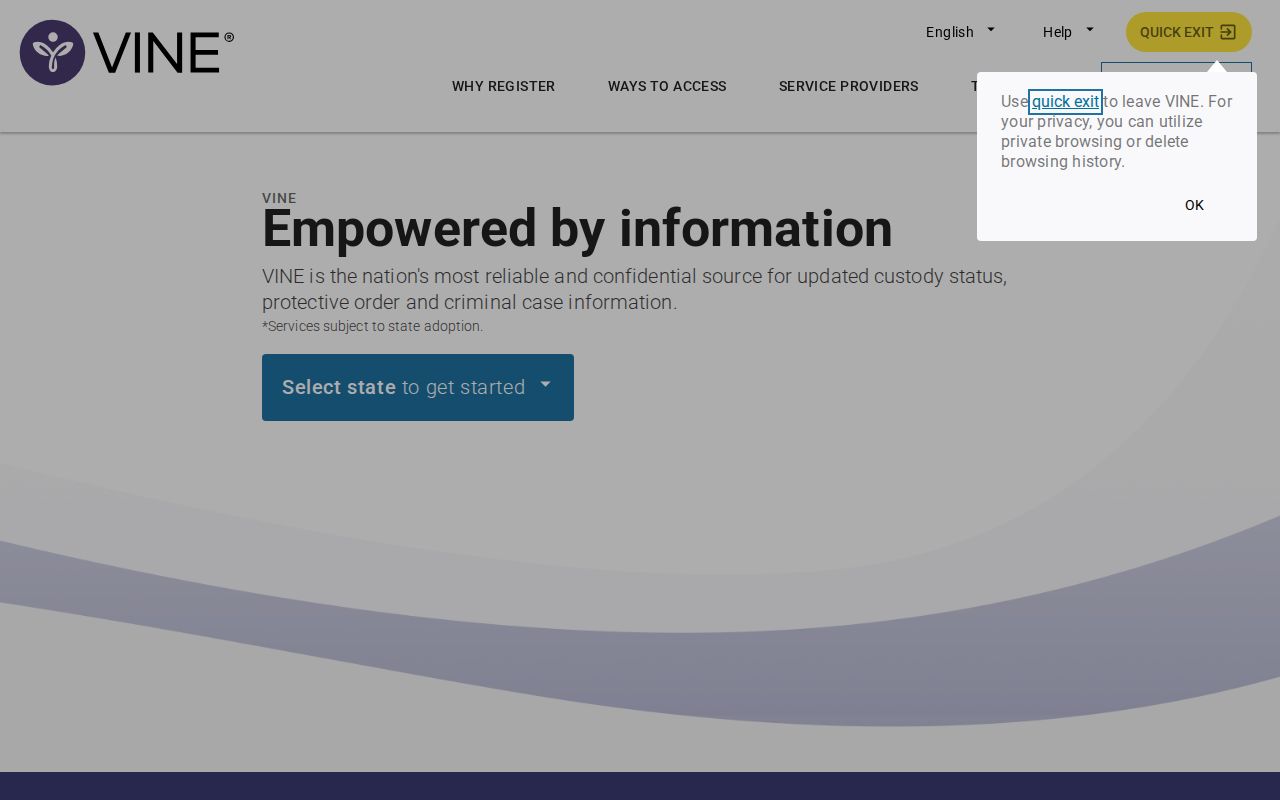
The interface is the place to verify the live agency label before relying on a Leelanau County release alert.
Register Leelanau Release Notifications
Registration begins from the matching person's record. Select notification and choose one or more destinations. MI-VINE supports phone, text, and email. Use only contact points that the registrant is authorized to use. More than one destination can be added, which can help when a single phone is unavailable. The alert category matters too. A release message and a transfer message require different follow-up checks.
- Open the verified person record and select the notification or registration option.
- Choose phone, text, email, or a combination of those methods.
- For a phone registration, create a four-digit PIN and keep it secure.
- When the automated call arrives, hear the message, enter the PIN, and then press the number sign.
- For text or email, review the event and agency. Those channels do not use the telephone PIN.
- After any alert, confirm the custody change with Jail Control, MDOC, or the court that supplied the event.
The official brochure says an unanswered phone call repeats until it is acknowledged or for up to 72 hours. If the PIN is forgotten, call 800-770-7657 and press 0. Representatives are available around the clock. TTY access is 866-847-1298. Acknowledgment stops that call cycle, but it does not certify the event or close a criminal case.
Note: Register before an expected custody change because MI-VINE is not designed as a permanent archive of old Leelanau County releases.
Leelanau Custody and Court Alerts
MI-VINE has a broader local role than a simple jail-release alarm. Official material separates county release, transfer, and escape notices from MDOC general-release notice. It also describes certain court disposition and hearing-change alerts. A Leelanau user may therefore monitor both the custody path and parts of the case path when live coverage supports them. Each alert still answers only the question assigned to that channel.
A court disposition can supply legal authority for release. It cannot show that staff finished checkout, and another charge or hold may keep the person confined. A transfer notice is stronger evidence that the original facility's custody ended, but it also says that custody continued. An MDOC general-release notice concerns the state system. Match the event to the agency before describing what happened.
- Release
- The reporting agency says its custody ended.
- Transfer
- The person left one location but remained in government custody.
- Disposition
- A court resolved or changed a legal issue in the case.
- Discharge
- MDOC jurisdiction ended; this may occur well after prison release on parole.
No Leelanau VINELink Record
A no-result search needs a jurisdiction check, not a broad conclusion. The person may have a jail-only case that never entered MDOC, a Leelanau event that was not supplied to MI-VINE, a name variation, a transfer to another county, or an event outside the notification archive. Search again with the exact spelling and offender ID when known. Then check whether a different agency was last known to hold the person.
For older Leelanau history, the durable paths are the retained Sheriff record and the court file. The county criminal-search launcher routes district matters to MiCOURT and felony records to the 13th Circuit search. Online court displays can have limits, and a docket is not a live custody system. Ask the clerk when a known case does not appear. A focused request through the Leelanau County FOIA channel can seek the admission time, release time, release type, holds, and public transfer destination.
OTIS is useful only when MDOC jurisdiction is plausible. It excludes county-jail and city-lockup cases and removes a public discharged record three years after the latest supervision discharge. A federal case belongs in the BOP inmate locator. BOP “Released” or “Not in BOP Custody” speaks only to BOP custody. It does not rule out another agency or continuing federal supervision.
Timing can also explain a missing or stale event. A participating agency must first send the change. The person may have been booked under a variant name, or the original jail may have recorded transport while the receiving system has not yet exposed a public match. Write down the search terms, reporting agencies, and times checked. That short record makes a follow-up call more precise and helps separate a delayed feed from a true identity mismatch.
Note: “Not found” describes the systems checked; it is not proof that no custody event, transfer, or release record exists.
Confirm Leelanau VINELink Releases
MI-VINE warns against relying on it alone. For a Leelanau County Correctional Facility record, use the official Sheriff corrections contact and call Jail Control at 231-256-8661. Ask whether the person remains held, when the person left, whether the event was community release or transport, and which agency controls any remaining hold. This wording avoids the false leap from “not here” to “released.” If documentary proof is needed, request the retained release record with the full name, date range, and booking number when known.
For a state prisoner, use MDOC OTIS. OTIS can show people now under MDOC supervision and those discharged within three years. “Parole” means prison release with supervision still in force. “Discharged” means MDOC jurisdiction ended. Jail-only Leelanau cases do not appear. A federal prisoner belongs in the BOP locator, and an immigration detention event belongs in ICE's system. VINELink is not the federal locator.
When a precise date or release type matters, reconcile the alert with the originating record. Jail Control confirms physical departure. The court file explains bond, dismissal, sentence, or commitment. OTIS describes state status. That layered check is especially important when the same name appears in more than one system.