
Leelanau Parole and Probation Compared
Parole and probation both allow a person to live in the community under rules, but they begin in different ways. The Michigan Parole Board is the sole paroling authority for people committed to the Michigan Department of Corrections. A parolee has left state prison while the MDOC sentence remains active. A sentencing court orders probation. District Probation handles local court functions, while MDOC Field Operations Administration supervises felony probationers shown in the state system.
A release from the Leelanau County Correctional Facility does not create parole or probation by itself. Someone may leave on bond with a criminal case still pending, finish a jail term with no supervision, enter probation under a judgment, or transfer to MDOC and remain confined. Read the court order and the corrections status together.
| Question | Parole | Probation |
|---|---|---|
| Who orders it? | Michigan Parole Board after a state-prison sentence | Sentencing court as a community sentence |
| What did custody status do? | State-prison confinement ended, but MDOC jurisdiction continues | May follow jail, replace confinement, or begin without a jail release |
| Public status | OTIS may show PAROLE and a Date Paroled | OTIS may show PROBATION for felony supervision |
| Who confirms terms? | Assigned MDOC field office | Sentencing court and assigned supervision office |
The distinction matters because a date of parole is not the same as discharge. Parole is an active phase of the sentence. Discharge means MDOC jurisdiction has ended.
Verify Leelanau Post-Release Supervision
Michigan OTIS is the public person lookup for state prisoners, parolees, felony probationers, and people discharged from MDOC within the public three-year window. It does not include a Leelanau jail-only sentence. Start with an MDOC number when known because it is the strongest match. A name search should be checked against aliases, age, physical descriptors, sentencing county, and court file.
- Open OTIS and search by MDOC number, or use the exact first and last name with useful filters.
- Select all statuses when looking for someone who has left custody. Open the full profile rather than relying on a result row.
- Read Current Status. PAROLE and PROBATION indicate active supervision; DISCHRG means MDOC jurisdiction ended.
- Compare Date Paroled, overall discharge date, sentence rows, sentencing county, court file, and assigned location.
- Call the listed field office when status, reporting instructions, or office assignment is unclear. Use the sentencing court for questions about a probation order.
A court record can fill the gap. Leelanau cases may appear through the 86th District MiCOURT entry or the 13th Circuit records search. A judgment or probation entry explains the legal status, while the field office confirms current supervision facts. For the jail release itself, use the broader Leelanau County released inmate search and record path.
OTIS date fields also need care. Date Paroled marks when a person left prison or acquired parole status. The overall Discharge Date marks the later end of MDOC jurisdiction. Earliest Release Date is when the Parole Board first gains jurisdiction for an ordinary indeterminate sentence, not a promised departure date. Maximum Discharge Date is the sentence endpoint shown under the applicable credit rules if parole does not occur. Reading one date without its label can turn active supervision into a false claim of final discharge.
Leelanau Supervision Office Details
The MDOC Region 2 directory lists a local office at the Government Center complex. The same telephone is also listed for the Grand Traverse County office in Traverse City. No separate public walk-in schedule was verified, so call before visiting and ask which location handles the case.
Leelanau County Parole/Probation Office
8525 E. Governmental Center Drive
Suttons Bay, MI 49682
Phone: 231-922-4380
Access: Call for current instructions; no local walk-in hours were published.
The assigned location shown in OTIS deserves close attention. Supervision can be transferred to another field office even when the sentence began in Leelanau County. The local office address alone does not establish that it supervises a given person.
The Michigan Parole Board has a different role. It decides whether an eligible state prisoner receives parole and sets the parole term and conditions. It is not the day-to-day field office. The Board can be reached at P.O. Box 30003, Lansing, MI 48909, 517-373-0270, or Parole-Board-Staff@michigan.gov for appropriate case information.
A positive Board decision is also not the walk-out event. MDOC states that its Parole Release Unit records the decision, parole date, term, and special conditions, sends notices, and coordinates placement. The agency describes an interval between the decision and physical release. Current status and Date Paroled in OTIS are therefore stronger evidence of departure than the fact that a grant was issued.
The official MDOC Region 2 office directory is the source for the Leelanau supervision listing.
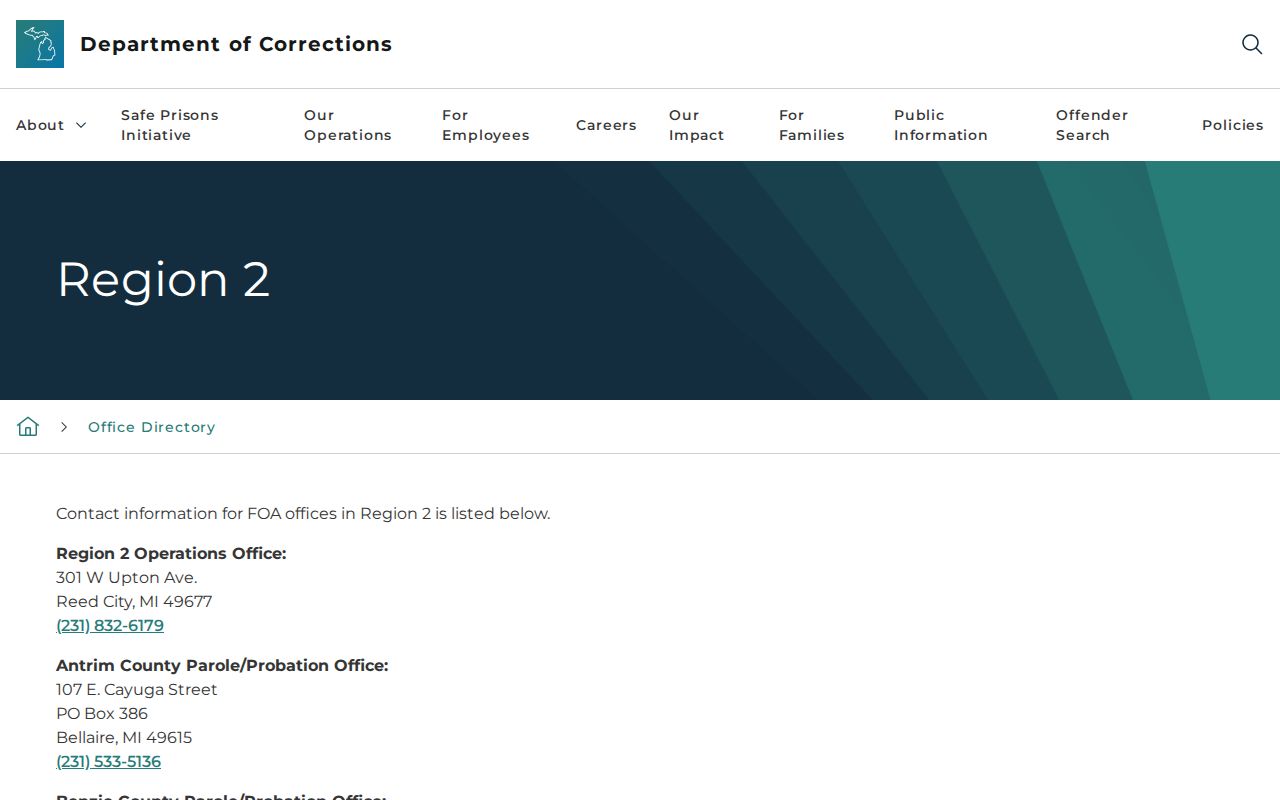
The directory connects a public OTIS status with the office that can clarify assignment and reporting instructions.
Leelanau Supervision Status Terms
Conditions are the rules attached to parole or probation. The exact terms come from the parole order, judgment, or supervising authority, not from a general status label. A reported violation may lead to review, a warrant, a change in conditions, or return to custody, but it does not by itself prove that supervision ended.
- Parole
- Release from state prison into continuing MDOC sentence supervision.
- Probation
- Court-ordered community supervision that may include conditions and reporting.
- Absconder
- A supervised person recorded as having failed to report and actively sought by the responsible authority.
- Discharge
- The end of MDOC jurisdiction for the displayed sentence or supervision term.
- Detainer
- A request or hold from another authority that may keep custody in place after one matter ends.
OTIS uses ABSCOND1 for a parole absconder sought by MDOC and ABSCOND2 for a probation absconder under the sentencing county’s jurisdiction. Neither label means discharge. No separate Leelanau public warrant list was found. Relevant urgent information goes to law enforcement, while record questions belong with the listed field office or court.
The MDOC Legislative Reports archive publishes quarterly aggregate parole decisions and absconder reports. These reports can show statewide counts and patterns, but they are not a name-by-name Leelanau supervision lookup. Individual status belongs in OTIS, the court file, and the assigned office. A report category should never be treated as proof about one person.
Leelanau Release and Status Alerts
MI-VINE supplies free custody and court-event notifications around the clock. County feeds can include release, transfer, and escape. MDOC registration can provide a general-release notice. Court-event registration may report disposition or hearing changes. Coverage must be checked in the live system because the reviewed current source did not prove Leelanau participation through a county matrix.
A VINE event is not a permanent supervision record. A transfer alert means the person left one agency but remained in custody elsewhere. A release alert reports the feeding agency’s change and should be checked with the Sheriff, MDOC, or court when exact type and time matter.
Registration is tied to a matching person record. Phone registration uses a four-digit PIN, and the automated call is acknowledged by entering that PIN followed by the pound sign. Unanswered calls can repeat until acknowledged or for the period described in the official brochure. Text and email registration do not use the phone PIN. MI-VINE can be reached at 800-770-7657, with TTY service at 866-847-1298.
When Leelanau Supervision Ends
Supervision ends through an official discharge, not merely because a person no longer reports to the same office. In OTIS, DISCHRG means MDOC jurisdiction ended for the displayed status. A discharged profile may show an overall discharge date and inactive sentence rows. If the person first left prison on parole, Date Paroled marks that physical departure, while the later discharge date marks the end of state jurisdiction.
Michigan law separates parole eligibility from actual release and final discharge. MCL 791.234 governs Parole Board jurisdiction and sentence-specific eligibility. MCL 791.233 sets the release standard. Reaching an eligibility point is not a release order, and leaving prison on parole is not sentence completion.
Probation ends under the court’s authority. The court file may show completion, discharge, modification, or a violation proceeding. Online dockets are informational, so a clerk record is the sound source when the exact disposition matters. State records and court records should be reconciled rather than treated as interchangeable.
Corrections to a supervision record follow the source of the error. A wrong judgment or sentence fact goes to the sentencing court. An assigned-office or absconder issue goes to the supervising agent or field office. MDOC states that OTIS is updated when it receives a court order or direction from the responsible agent. General OTIS accuracy questions may be sent to correctionsinfo@michigan.gov. This division keeps a public status question from being sent to an office that cannot change the underlying order.
A later MDOC episode can also change what remains public. OTIS keeps a discharged record for three years from the most recent supervision discharge, so a new case can restart that public window. The date on the profile must be matched to the correct sentence row and court file.
Note: Confirm the custody system first, because a county jail release, state parole, and final MDOC discharge describe three different events.