
Understanding Leelanau County Releases
A Leelanau County release means the Sheriff’s control over a booking has ended. It does not always mean the person is free of all custody. A person may leave after bond, a dismissal, time served, a sentence outdate, or a court order. Another person may be moved to a Michigan Department of Corrections prison, a different county, federal custody, or immigration custody. Those transfers close the Leelanau stay but do not return the person to the community. The agency that caused or received the departure holds the best next record. Jail Control can confirm physical departure from the Leelanau County Correctional Facility. The court docket explains the legal event. MDOC’s Offender Tracking Information System, called OTIS, shows state prison and supervision status. Federal and immigration systems answer narrower custody questions. Boarded people may be physically held by Leelanau County while another county controls the outdate. A Grand Traverse Band matter can involve Tribal Court authority and a Leelanau County jail record without a separate tribal jail. Reading these sources together prevents a common mistake: treating a missing local name as proof of community release.
- Time served
- A court-approved sentence satisfied by days already spent in custody.
- Parole
- Conditional community supervision after release from an MDOC prison.
- Probation
- A court sentence served in the community under stated conditions.
- Discharge
- The end of MDOC jurisdiction, which may occur well after prison release.
- Detainer
- A request or authority that may send a person to another agency instead of the community.
Leelanau County Release Paths
Each Leelanau County release path creates a different paper trail. Bond and dismissal are court events, yet Jail Control confirms when checkout is complete. A local sentence outdate comes from jail staff after all charges are sentenced and credits are applied. State parole starts with a Michigan Parole Board decision and ends prison confinement, but MDOC supervision continues. A transfer means the receiving system becomes the current source. Boarded people add another layer because the sentencing county supplies the outdate and release rule even while Leelanau County staff carry out the physical custody. The release record should therefore identify both the event and the authority behind it.
| Departure type | What it means | Best next source |
|---|---|---|
| Bond | The case continues outside jail, subject to the court’s terms. | Jail Control and the 86th District or 13th Circuit docket |
| Time served or outdate | The local jail sentence has reached its calculated end. | Leelanau jail release record |
| Dismissal or court order | Legal authority exists to release on that matter. | Court clerk, then Jail Control for physical departure |
| MDOC parole | Prison custody ends and community supervision begins. | OTIS Date Paroled and current status |
| Transfer | Leelanau custody ends, but another agency takes control. | Receiving county, MDOC, BOP, ICE, or tribal authority |
Death or escape can also end a Leelanau County custody episode, but neither should be described as an ordinary release. Ask for the release type, receiving agency, and destination when public. These fields explain what “left custody” actually means. A court dismissal can supply legal authority on one charge while another warrant or hold keeps the person confined. A bond receipt proves a court transaction, not the time the jail completed checkout. An MDOC assignment proves that Leelanau County custody ended through transfer, not community release. Precise labels keep these very different outcomes from being collapsed into one word.
Leelanau County Release Record Fields
A focused Leelanau County release record links the booking to its outcome. The county has no public release archive, so a retained record must usually be requested. Useful identifiers include a full name, date of birth or booking number, and a narrow booking range. Ask for the fields that answer the question instead of asking the county to create a new list. The admission and release timestamps define the custody span. The disposition or release type explains the recorded reason for departure. Hold, transfer, and receiving-agency fields show whether custody continued. Outdate entries can document local time served and Sheriff’s good time. A booking number ties those items to the correct Leelanau County intake when names are similar.
| Field | What it establishes |
|---|---|
| Admission date and time | When the Leelanau custody episode began |
| Release date and time | When physical control ended |
| Release type or disposition | Bond, sentence end, court order, transfer, or another recorded event |
| Booking number | The local record identifier that separates similar names |
| Hold or receiving agency | Whether custody continued elsewhere |
| Outdate entries | Time served and Sheriff’s good-time calculation for a local sentence |
| Booking photograph | The image tied to that booking, if retained and releasable |
A court disposition explains legal authority. The jail release timestamp confirms physical departure. One should not be substituted for the other.
Note: Ask for the receiving agency whenever a Leelanau County release entry records a transfer rather than a return to the community.
Request Leelanau County Release Records
The Leelanau County FOIA page provides the official request route. Katie Smielewski is the county FOIA Coordinator. Written submissions may be sent to FOIA@leelanau.gov, with questions to ksmielewski@leelanau.gov. The mailing address is 8527 E. Government Center Drive, Suite 202, Suttons Bay, MI 49682. The office phone is 231-256-9872 and fax is 231-256-0133. A request need not use special words, but it must describe an existing Leelanau County record well enough for staff to find it. Supplying the facility, identity details, booking range, and desired fields makes the request more precise and can reduce search time.
- Identify the person with a full name and date of birth or booking number.
- Give an approximate booking date range and name the Leelanau County Correctional Facility.
- Request retained admission, release, disposition, hold, transfer, outdate, and booking-photo records.
- Ask for electronic copies and state a fee limit or request an estimate above a chosen amount.
- Keep the response letter. A partial denial or denial should identify the basis used.
Michigan FOIA requires a grant, denial, partial grant, or extension response within five business days after legal receipt. One written extension of up to ten business days is allowed. That deadline governs the decision, not guaranteed delivery of all records. Fees depend on permitted actual labor, copying, and mailing costs, so there is no flat Leelanau County release-record price. Electronic delivery and a narrow date range may reduce cost. If a response withholds or redacts material, it should identify the legal basis used. Court files are requested from the court clerk instead because Michigan FOIA does not treat the judiciary as a public body under this process.
The official FOIA page and request channel are shown in the county’s captured interface below.

The page confirms where a precise written request goes when no release list exists.
Michigan Law and Leelanau Releases
Michigan’s Freedom of Information Act, MCL 15.231 through 15.246, applies to existing records held by public bodies. MCL 15.235 sets the response options and timing. MCL 15.234 governs allowed fees. The law does not require Leelanau County to create a daily release feed that it does not keep, and it establishes no universal jail-record retention term. Court files follow a different route because Michigan FOIA excludes the judiciary from its definition of public body. Request those records from the clerk under court access rules. Eligible convictions may also be removed from public view under Michigan’s automatic set-aside process. The research identifies general automatic waiting periods of seven years for eligible misdemeanors and ten years for eligible felonies, subject to statutory exclusions and the later MDOC-release rule. A missing court or OTIS result can therefore reflect display rules, age, or set-aside treatment. It does not prove that no custody or release occurred. For county good time, MCL 51.282 permits one day for each six days of sentence when the person has no rule violation, subject to forfeiture and possible restoration. That county rule differs from Michigan’s state-prison truth-in-sentencing framework.
Note: A missing online Leelanau County record can reflect lawful access limits or retention, not the absence of an earlier release.
When Leelanau Jail Releases Occur
The Sheriff’s corrections page publishes a rare local detail. For a person serving a Leelanau sentence, the jail sets an outdate after sentencing on all charges and applies time served plus eligible Sheriff’s good time. The posted policy then ties release time to a required down payment on jail room-and-board debt. A locally sentenced person who makes the 15 percent down payment is released at 6:00 a.m. on the release date. A person who cannot make it is released at 11:00 p.m. The rule is narrow. It should not be applied to a bond checkout, immediate court order, medical departure, transfer, or a boarded person whose sentencing county controls the outdate.
The county’s official corrections page displays that release and outdate context.

Because the public page has no roster or recent-release control, Jail Control remains the direct check for a completed departure.
Getting Home After Leelanau Release
The jail does not promise transportation after release. BATA Route 10 reaches Suttons Bay, but the reviewed fixed-stop information does not name the Government Center or jail as a stop. County court directions place the complex west of town. A person expecting release should confirm the nearest stop or a possible deviation with BATA Village Loops or arrange a pickup. This matters most for the published 11:00 p.m. release. A scheduled outdate is not a bus schedule, and a family member should not assume a vehicle may wait at an unlisted jail pickup point. Jail Control can confirm facility procedure, while BATA can answer route questions.
Note: Confirm both the Leelanau County release time and the ride plan before relying on a late fixed-route connection.
Bond and Leelanau Release Timing
Bond may be posted at the relevant court during business hours or through the kiosk in the Sheriff’s lobby after hours. The bond money belongs to the court, and bond questions go to the court. Payment does not by itself prove the person has walked out. Jail processing may remain, and another hold can prevent community release. Confirm both parts. First, verify the court received and accepted the bond. Then ask Jail Control whether the person physically left and whether another agency assumed custody. The county’s 2023 report also documents pretrial assessment and supervision as a local detention alternative, but those program totals are not a list of released people.
Leelanau Release Program Numbers
The 2023 Community Corrections report gives Leelanau County context without naming individuals. It records four jail-alternative assessments, three enrollments, and three positive completions, with no failed or returned participants. The program reported 2.24 average daily beds saved and 294 bed-days saved. Pretrial work included 31 assessments, 29 felony defendants supervised, and five failures returned on bond. These counts describe services and supervision during the reporting period. They do not supply booking numbers, release dates, or a way to identify a person. Their value is in showing how local court-supervised alternatives can change who remains in the Leelanau County jail on a given day.
These figures describe programs and caseload. They cannot identify who left the jail on a given date. A named-person search still requires Jail Control, a court record, VINE, OTIS when applicable, or a focused records request.
Leelanau Jail Fees at Release
Leelanau publishes room-and-board charges for sentenced people. The stated rate is $40 for the first sentenced day and $15 for each later day. Court-approved work release is $40 for the first day and $20 for later days. Unsentenced people are not charged jail room-and-board fees. An inmate worker does not accrue further room-and-board fees while that status continues. Court fines and costs are separate. Boarded people follow the boarding county’s billing and release rules. The 15 percent down-payment policy affects the posted time for a local sentence release, not whether a court fine has been paid. A personal balance should be confirmed with the jail rather than calculated from the general schedule.
Note: The posted Leelanau County rates are general figures; Jail Control must confirm a person’s actual balance and release-time category.
Find Leelanau County Released Inmates
No official Leelanau County recent-release feed was verified. A dependable search therefore checks the physical departure, its legal cause, and any receiving custody. Start with exact identity details. Similar names and incomplete dates can lead to the wrong record. Use a date of birth, booking number, MDOC number, court file, or other lawful identifier when available. Then keep each system within its scope. Jail Control answers the Leelanau County physical-custody question, the court explains legal authority, OTIS covers MDOC jurisdiction, and a federal locator applies only to its own agency. The final record should reconcile the person, event, and destination.
- Call Jail Control at 231-256-8661 and ask whether the person left Leelanau custody.
- Ask whether the event was bond, outdate, court order, transfer, escape, death, or return to a boarding county.
- Use the county’s official criminal-search launcher for the 86th District or 13th Circuit docket.
- Check OTIS if a felony sentence or MDOC transfer is possible.
- Use MI-VINE for a reported custody change, then confirm the event with the feeding agency.
- Use BOP or ICE only when federal or immigration custody is plausible.
- Request the retained jail release record when documentary proof is needed.
A released person will not remain on a live custody roster. Roster absence alone cannot distinguish release from transfer.
Search MDOC Records After Release
The Michigan Department of Corrections OTIS gateway covers prisoners, parolees, probationers, and people discharged within the public retention window. It does not cover a person whose only custody was the Leelanau County jail. A person moved from Leelanau County to state prison remains in custody even though the county booking closed. Begin with an MDOC number when known because it is more precise than a name. Otherwise, use the available name and identity filters, then compare status, location, sentence county, and other profile details. A namesake should never be selected from the name alone.
| OTIS field | How to read it |
|---|---|
| MDOC Number | The most precise state identifier |
| Status | Prison, parole, probation, discharged, or another MDOC category |
| Earliest Release Date | First ordinary parole eligibility point, not a promised release |
| Date Paroled | Past physical departure from prison to supervision |
| Maximum Discharge Date | Maximum sentence endpoint if controlling |
| Discharge Date | End of MDOC jurisdiction |
The public OTIS record for a discharged person generally remains available for three years. Older discharges can disappear, and jail-only Leelanau County cases never enter OTIS. Search by MDOC number when known, or use a name with available narrowing details. Match more than a name. Read Current Status before drawing a conclusion from any date. Date Paroled marks the move from prison to community supervision. Discharge Date marks the later end of MDOC jurisdiction. Earliest Release Date is an eligibility field, not a promised walk-out date, while Maximum Discharge Date reflects the controlling maximum under the applicable rules.
The official OTIS gateway below is the statewide starting point for a Leelanau release that became an MDOC case.
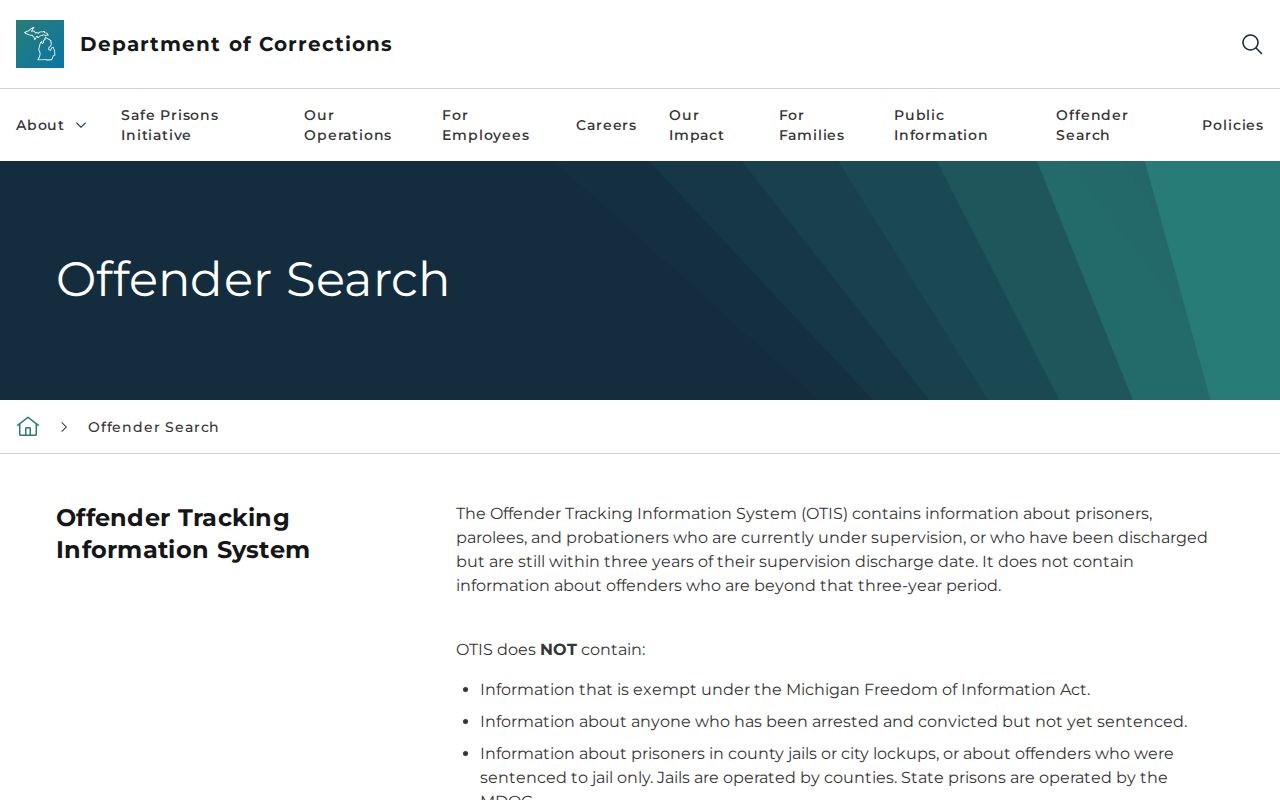
Its result must be read by status: parole is community supervision, while discharge is the later end of MDOC authority.
Leelanau County Recent Release Checks
The Sheriff does not publish a verified 24-hour or 72-hour released-person list, public roster, or jail app. The official Facebook account is not a release feed. A commercial page that uses the county name does not become an official source. The honest recent-release route is Jail Control, followed by the court, VINE, and a county FOIA request. For a same-day event, give Jail Control a clear 24-hour period. For a three-day check, state the exact start and end times, especially across a weekend or holiday. The separate Leelanau County 24-hour release list page explains that no public feed was found and sets out the direct fallback.
Note: A precise date-and-time window helps Leelanau County staff identify the underlying entries without creating a new public release list.
Leelanau Release Court Record Search
Leelanau participates in a shared court structure. The county’s official criminal-records launcher directs district matters to MiCOURT and circuit matters to a Grand Traverse County-hosted system. That outside host can still be the official path because the 86th District and 13th Circuit serve more than one county. Look for arraignment, bond, dismissal, plea, sentencing, credit for time served, probation, commitment, and discharge-related entries. MiCOURT says online data is informational, some criminal displays use a seven-year filter, and not every court participates. Automatic set-aside reconciliation can also affect what appears. When a known case is missing, contact the clerk instead of treating the blank result as proof.
Verify Leelanau Post-Release Supervision
Parole and probation are different. Parole follows an MDOC prison term and remains under state field supervision. Probation is imposed by a court and may occur without a prison sentence. OTIS can show a state supervision status, while the court docket explains the sentence. The Leelanau County Parole/Probation Office is at the Government Center complex and can confirm the proper local route. An absconder label means the supervising agency reports that contact has been lost or a violation process is active. It does not explain the whole case. The Leelanau parole and probation page separates office verification, OTIS status, court probation, and eventual discharge.
Leelanau Release Alerts and Federal Records
Michigan operates MI-VINE through VINELink, mobile access, and telephone. It can report custody changes from a participating agency and can send phone, text, or email alerts. Current Leelanau participation was not proved by the reviewed statewide material, so select Michigan and verify the reporting agency in a live search. County feeds can distinguish a release, transfer, or escape, while MDOC registration can report a general release and certain court registration can report a disposition or hearing change. A transfer alert means custody continued elsewhere. A release alert is useful, but VINE itself warns users not to rely on it alone. Confirm the release type and time with the Sheriff, MDOC, or court. The BOP locator covers federal prisoners from 1982 to the present and may show “Released” or “Not in BOP Custody.” Those labels mean BOP no longer holds the person, not that no other agency does or that federal supervision ended. The ICE Online Detainee Locator System covers current detainees and people released within the last 60 days, with stated exclusions and lag. A county departure on an immigration detainer is a transfer.
The United States Marshals Service has no comparable public historical release locator and often uses state, local, private, or BOP facilities. Identify the actual jail or prison and the federal docket before choosing the next search. A Leelanau County departure into Marshals, BOP, or ICE control is a transfer even when the local stay closes. The Michigan Sex Offender Registry is another narrow check for a person who has a legal duty to register, but it is not a general release search and cannot establish a Leelanau County jail departure. Registry status and a release record answer different questions.
Note: Every federal or registry result needs a separate Leelanau County release check when the local jail departure remains the question.
Compare Leelanau Release Search Systems
Use the system that matches the custody type and time period. No single source covers every Leelanau County release.
| Source | What it can show | Main limit |
|---|---|---|
| Jail Control and county record | Local physical departure, type, and transfer detail | No verified public roster or recent-release feed |
| MiCOURT or circuit record | Legal event behind bond, sentence, dismissal, or probation | Not the physical checkout time |
| OTIS | MDOC prison, parole, probation, and recent discharge status | No jail-only cases; discharged display is time-limited |
| MI-VINE | Reported custody changes and alerts | Coverage and data timing must be checked |
| BOP locator | Federal release date and BOP status | Does not rule out other custody or supervision |
| ICE locator | Current custody or a recent immigration release | Released-person window is limited to 60 days |
Why can every online search be blank? A jail-only case may never enter OTIS, a discharge may be older than its three-year display, an ICE release may be older than 60 days, or a court record may be filtered or set aside. “Not found” is the accurate conclusion.
Leelanau County Release Destinations
The facility map follows custody beyond the county jail. Each link explains which agency controls the record and how to distinguish release from transfer.
- Leelanau County Correctional Facility: local jail releases, bonds, outdates, and transfers.
- Michigan Department of Corrections institutions statewide: state prison, parole, and discharge records in OTIS.
- Other county jails used for boarding or transfer: the sentencing or boarding county may control release.
- Federal Bureau of Prisons institutions: federal custody and released status through the BOP locator.
- ICE detention system: immigration custody and a limited recent-release search.
- Grand Traverse Band Tribal Court and public safety: tribal court records reconciled with county custody.
No state prison, federal prison, separate tribal jail, or verified ICE detention site was found in Leelanau County. These pages describe systems that may receive or govern a person after a Leelanau custody event, not six local jail buildings.
Note: The facility list follows possible custody destinations and record systems; it is not a count of detention buildings inside Leelanau County.